
Quick Summary
Scientists using cutting-edge DNA technology have identified the remains of Private John Pumphrey, a Maryland teenager who enlisted in the Continental Army at around age 13 and died at the Battle of Camden in 1780, marking the first successful identification among 14 unknown soldiers unearthed from the South Carolina battlefield in 2022. The breakthrough, unveiled in June just weeks before America’s 250th anniversary, used the same forensic genetic genealogy techniques that helped catch the Golden State Killer, adapted for the first time to identify remains this old.
What Happened
Researchers announced the identification of remains previously catalogued only as “Camden 9B” as Private John Pumphrey of Anne Arundel County, Maryland, before members of his extended family gathered in Baltimore on June 18. Genetic genealogist Allison Peacock, founder of FHD Forensics, said her team used “three different types of DNA” combined with biographical and historical records to confirm the match, calling the moment one that gave her “goosebumps.”
Pumphrey enlisted in the Continental Army’s 7th Maryland Regiment on January 5, 1777, after leaving his rural Anne Arundel County home for Baltimore following his father’s death and a dispute that cost the family its estate. Records show he marched more than a thousand miles with his regiment, fighting at the battles of Brandywine and Germantown in Pennsylvania and Monmouth in New Jersey, and surviving two brutal winters encamped at Valley Forge and Morristown. He died at the Battle of Camden on August 16, 1780, felled by a British musket ball in what became one of the bloodiest engagements of the Revolutionary War.
Background
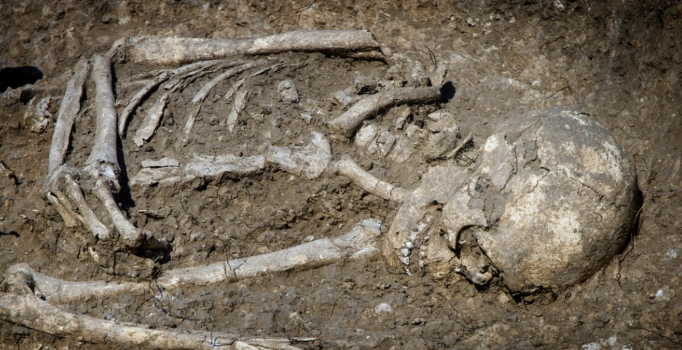
Archaeologists from the University of South Carolina, led by James Legg and Steve Smith, uncovered 14 sets of unidentified Continental Army remains at the Camden battlefield in 2022, work that began in earnest during the COVID-19 pandemic when Legg turned to extensive metal detecting on the site. The graves were shallow, some barely 14 inches deep, likely dug hastily by fellow Continental soldiers taken prisoner by the British, using little more than their hands and improvised tools.
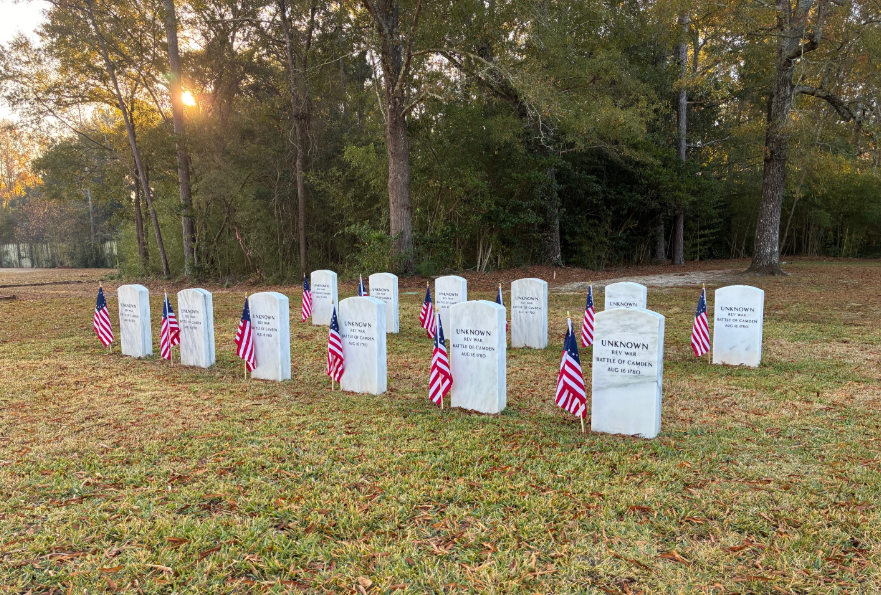
The remains were reburied in a formal 2023 ceremony that drew hundreds of attendees, including Revolutionary War reenactors and a flyover from the 79th Fighter Squadron. At the time, researchers held only a hope that DNA science might eventually reveal who these men actually were. That hope was realized this year through investigative genetic genealogy, a technique developed for modern forensics that uploads a DNA profile to public genealogy databases to find distant living relatives, then works backward through family trees to identify the original source. The same underlying method famously identified Joseph James DeAngelo as the Golden State Killer in 2018, though applying it to remains nearly two and a half centuries old required extracting and sequencing ancient, degraded DNA, a considerably harder technical challenge than working with modern crime-scene samples.
Why It Matters
Pumphrey is the first of the Camden 14 to be identified, but researchers are already working toward a second: a soldier currently known only as “11A,” whose DNA traces to a man named Robert Fleming, believed to have helped found a colonial-era church in York County. Peacock noted she is personally related to that second unidentified soldier, adding a layer of personal connection to the ongoing research.
At least 12 of the 14 men recovered from the Camden site are considered among the United States’ first veterans. The other two were a Native American who likely fought on the Loyalist side and a British Highlander from the 71st Regiment of Foot, meaning the battlefield holds soldiers from opposing sides of the same conflict, buried together in the chaos that followed the fighting.
Expert Analysis
Historical impact: The identification arrives during the year the United States marks the 250th anniversary of its founding, giving Pumphrey’s story particular resonance as a tangible, individually named connection to a war that is otherwise remembered largely through collective and abstract commemoration.
Scientific impact: Successfully sequencing usable DNA from remains this degraded represents a meaningful technical achievement for forensic genetic genealogy, a field that has grown rapidly since 2018 but has been applied almost exclusively to relatively recent cold cases and missing persons rather than 18th-century remains.
Genealogical impact: Peacock’s team found that despite Pumphrey’s immediate family line having died out, he has hundreds of distant living relatives, nieces, nephews, and cousins many generations removed, who now know his story for the first time, illustrating how genetic genealogy can restore identity even when no direct descendants remain.
Funding impact: The identification effort relied on grants from the Archaeological Research Trust and crowdfunding through Genealogy For Justice, alongside the genetic relatives of earlier identified subjects, highlighting how projects like this depend on a patchwork of nonprofit and public support rather than a single dedicated funding stream.
Statistics & Context
Pumphrey was among 14 unidentified Revolutionary War soldiers recovered from the Camden, South Carolina battlefield in 2022, following his death on August 16, 1780, at roughly 16 or 17 years old. His identification, unveiled in June 2026, arrived 246 years after his death and just weeks before the United States marked its 250th anniversary of independence.
What’s Next
Researchers have already begun work on identifying “Camden 11A,” the soldier linked to the Fleming family line, with hopes of eventually naming additional soldiers among the remaining 13 unidentified remains as DNA sequencing technology continues to improve and additional funding becomes available. Pumphrey’s gravestone in South Carolina, currently marked “Unknown,” will soon be updated to bear his name.
FAQ
Who was John Pumphrey?
He was a teenage soldier from Anne Arundel County, Maryland, who enlisted in the Continental Army’s 7th Maryland Regiment at around age 13 and died at the Battle of Camden in 1780.
How was he identified after 246 years?
Researchers used investigative genetic genealogy, extracting ancient DNA from his remains and matching it against public genealogy databases to trace living relatives, then working backward through historical and family records to confirm his identity.
Is this the same technology used to catch famous criminals?
Yes. The underlying method is the same used to identify the Golden State Killer in 2018, though applying it to remains this old required more advanced techniques for sequencing degraded ancient DNA.
How many soldiers were found at the Camden site, and how many have been identified?
Fourteen sets of remains were recovered in 2022. Pumphrey is the first to be identified, with researchers currently working on a second soldier known as “Camden 11A.”
Does John Pumphrey have any living relatives?
His direct family line has died out, but researchers identified hundreds of distant living relatives, nieces, nephews, and cousins many generations removed, some of whom gathered in Baltimore to hear his story for the first time.
Editorial Note: This article was prepared using publicly available information from international news organizations, research institutions, and official sources available at the time of publication. Facts may be updated as authorities release new information.
Sources: