
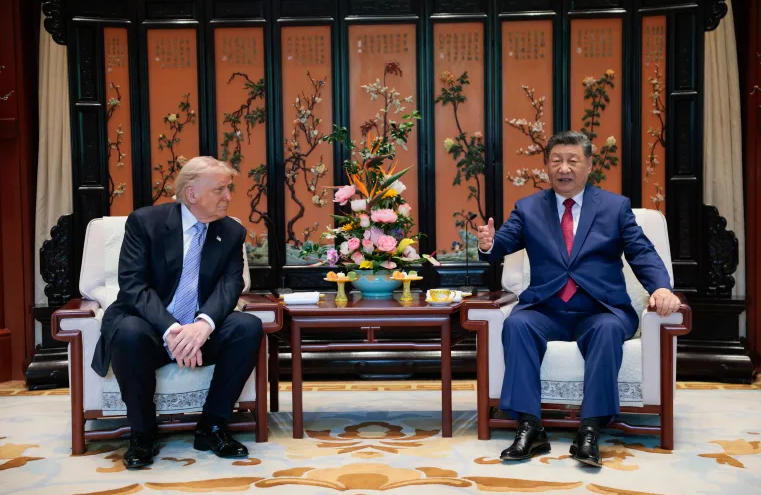
The Trump Xi summit concluded in Beijing on May 15, 2026, with both sides announcing limited preliminary agreements on agricultural trade while leaving the world’s most pressing issues, including Taiwan, Iran and artificial intelligence, largely unresolved.
The two-day summit at Beijing’s Great Hall of the People was the first visit by a sitting US president to China in nearly a decade, and brought together the leaders of the world’s two largest economies against the backdrop of the Iran war, trade tensions and rising geopolitical rivalry.
What was agreed:
China and the United States agreed to expand agricultural trade through mutual tariff reductions and tackle non-tariff barriers on market access. China granted five-year registration extensions to 425 US beef plants that had been shut out after their registrations lapsed, and approved new five-year registrations for 77 additional US facilities. US Trade Representative Jamieson Greer said the US expects China to buy “double-digit billions” worth of US farm goods over the next three years. All agreements were described as “preliminary” by China’s commerce ministry, to be “finalized as soon as possible.”
What was not resolved:
President Xi Jinping issued a blunt warning on Taiwan, telling Trump that the US and China “will have clashes and even conflicts” if the long-standing issue of Taiwan’s independence is mishandled. Xi called Taiwan “the most important issue in China-US relations,” reiterating that Taiwan independence and peace in the Taiwan Strait “are as irreconcilable as fire and water.”
On Iran, Trump told Fox News that Xi expressed a desire to help reopen the Strait of Hormuz and claimed Xi pledged not to supply Iran with military equipment. Beijing has not confirmed either statement.
What comes next:
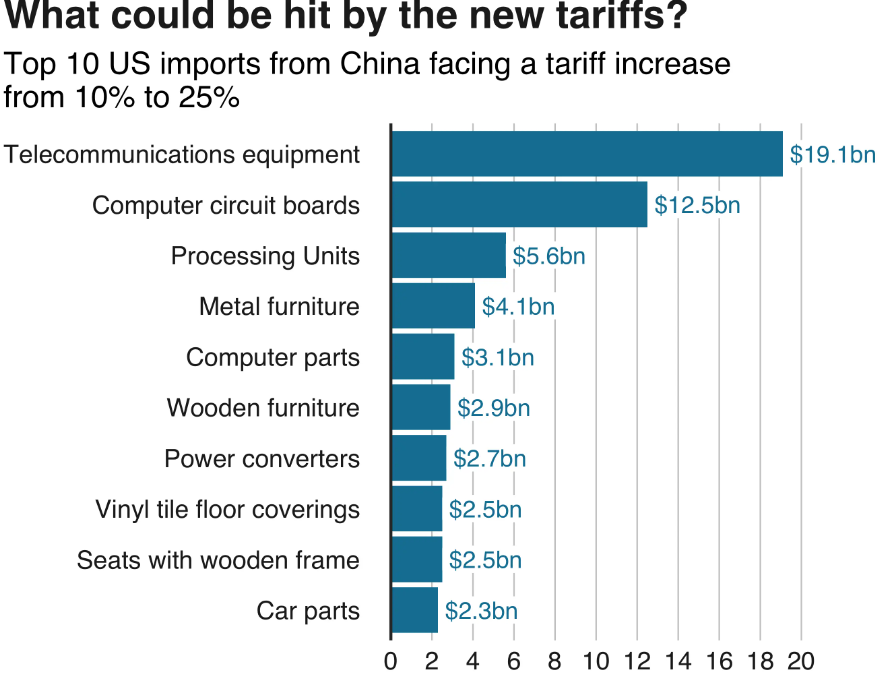
Despite the diplomatic handshakes and state banquets, the US is preparing new targeted tariffs on Chinese goods, particularly in the technology and semiconductor sectors. Trump invited Xi for a reciprocal White House visit on September 24, which Beijing has not yet confirmed.
Trump’s delegation included a who’s who of American business: Elon Musk of Tesla, Tim Cook of Apple, Larry Fink of BlackRock, Jensen Huang of Nvidia and Kelly Ortberg of Boeing. Musk told reporters “many good things” had been achieved. Cook gave reporters a peace sign and a thumbs up. Xi told the CEOs that “China’s door would only open wider.”
But analysts remain cautious. “China comes into this meeting far more confident than in 2017, when it feared even a small rise in US tariffs,” said Scott Kennedy of the Center for Strategic and International Studies. “Xi has been able to push back and neutralize much of Trump’s actions.”