
Quick Summary
The United States men’s national team defeated Bosnia and Herzegovina 2-0 on Wednesday to reach the World Cup round of 16, but the win came at a steep cost: star forward Folarin Balogun was sent off in the 64th minute for a challenge widely criticized as harmless by pundits, coaches, and even a former Premier League referee. FIFA has confirmed there is no appeal process, meaning Balogun will miss the Americans’ round of 16 match against Belgium, and the team could face an even longer suspension if FIFA’s disciplinary panel decides the offense warrants it.
What Happened
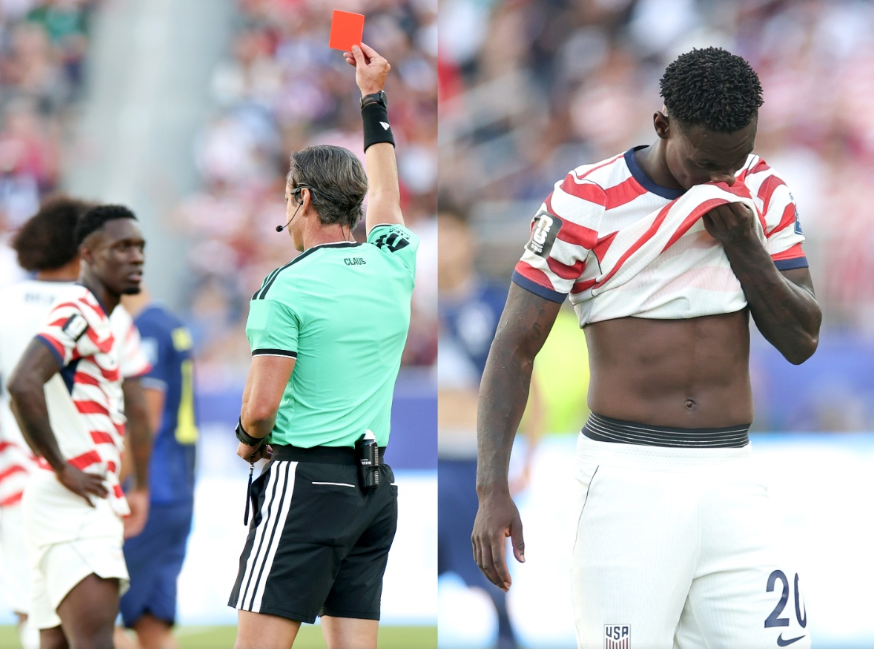
Balogun opened the scoring just before halftime, contorting his body to slot home his third goal of the tournament and giving the United States a 1-0 lead over Bosnia-Herzegovina in Santa Clara. Early in the second half, he was challenging Bosnian defender Tarik Muharemovic for the ball when his studs dragged down the back of Muharemovic’s leg and onto his foot as both players fell. Referee Raphael Claus initially allowed play to continue, but VAR flagged the incident for review.
After examining the replay on the pitchside monitor, Claus showed Balogun a straight red card in the 64th minute for serious foul play, ejecting him from the match and triggering an automatic one-game suspension. Playing a man down for the final 36 minutes plus stoppage time, the United States still doubled its lead when midfielder Malik Tillman buried a free kick to make it 2-0, sealing the country’s first World Cup knockout-round win since 2002.
Background
Under FIFA’s 2026 World Cup regulations, referee decisions regarding facts connected with play are explicitly final and not subject to appeal. Article 9.6 of the tournament rules states that such calls “are final and not subject to appeal,” meaning neither Balogun nor U.S. Soccer has any formal mechanism to contest the red card itself, only the length of any suspension beyond the automatic one-match ban.
Balogun’s dismissal was the 12th straight red card of the tournament, all of them issued without a prior yellow card. Former Select Group Premier League referee Andy Davies told ESPN the challenge was “purely accidental” and did not, in his opinion, warrant a red card. Head coach Mauricio Pochettino was even more direct in his postgame comments, comparing the incident to an unpunished similar challenge involving Lionel Messi against Algeria earlier in the tournament. “For me, both were not a red card,” Pochettino said.
Why It Matters
The suspension strips the United States of its leading scorer heading into a round of 16 match against Belgium on July 6 in Seattle, a significant tactical blow at the tournament’s most demanding stage. Beyond the immediate competitive impact, the incident has reignited a long-running debate about VAR’s reliance on slow-motion replay to judge fouls that occur at full speed, with critics arguing the technology can make routine physical contact look more severe than it actually was in real time.
There is also a financial and reputational dimension. Should FIFA’s disciplinary panel decide to extend Balogun’s ban beyond the automatic one match, drawing a parallel to Qatari midfielder Assim Madibo, whose one-match ban was extended to five games earlier in the tournament after a challenge that broke an opponent’s leg, U.S. Soccer has already stated it would appeal any suspension longer than a single game.
Expert Analysis
Competitive impact: Losing a tournament’s top scorer for a knockout match against a strong Belgian side represents one of the more consequential in-tournament suspensions the U.S. men’s team has faced in recent World Cup history, particularly given how few clear scoring chances national team matches typically generate at this level.
Officiating impact: The debate around Balogun’s red card adds to a broader pattern of inconsistency complaints at this World Cup, with multiple pundits and players noting that visually similar challenges have received different treatment throughout the tournament, a criticism that touches on VAR’s core promise of consistent, error-free officiating.
Institutional impact: FIFA’s decision on whether to extend Balogun’s suspension will be closely watched as a signal of how the governing body is calibrating discipline standards at its flagship tournament, particularly given the precedent set by the Madibo case earlier in the competition.
Statistics & Context
Balogun’s red card was the 12th issued at the 2026 World Cup, with every dismissal so far being a straight red rather than a second yellow card. He finished the group and round-of-32 stage as the United States’ top scorer with three goals in the tournament and 12 goals in 30 international appearances overall since debuting in 2023.
What’s Next
The United States faces Belgium in the round of 16 on July 6 in Seattle without Balogun available. FIFA’s disciplinary panel has not announced whether it will review extending his suspension beyond the automatic one-game ban, and U.S. Soccer has stated it will formally appeal if any extension is issued.
FAQ
Why was Folarin Balogun given a red card?
He was shown a straight red card in the 64th minute for a challenge in which his studs caught the ankle and Achilles of Bosnia-Herzegovina defender Tarik Muharemovic during a contest for the ball, which VAR review determined constituted serious foul play.
Can the United States appeal the red card?
No. FIFA confirmed to ESPN and ABC News that World Cup regulations do not allow referee decisions on facts connected with play to be appealed. U.S. Soccer can only appeal if FIFA’s disciplinary panel extends the suspension beyond the automatic one-game ban.
Will Balogun play against Belgium?
No. The automatic one-match suspension triggered by his red card rules him out of the United States’ round of 16 match against Belgium on July 6.
How did the United States win despite playing a man down?
Midfielder Malik Tillman scored a free kick in the second half to make it 2-0, with the American defense holding firm for the remainder of the match after Balogun’s ejection.
Has FIFA extended similar red card suspensions before at this tournament?
Yes. Qatari midfielder Assim Madibo had his one-match ban extended to five games after a challenge that broke Canada’s Ismaël Koné’s leg earlier in the tournament.
Editorial Note: This article was prepared using publicly available information from international news organizations and official sources available at the time of publication. Facts may be updated as authorities release new information.
Sources: