
Quick Summary
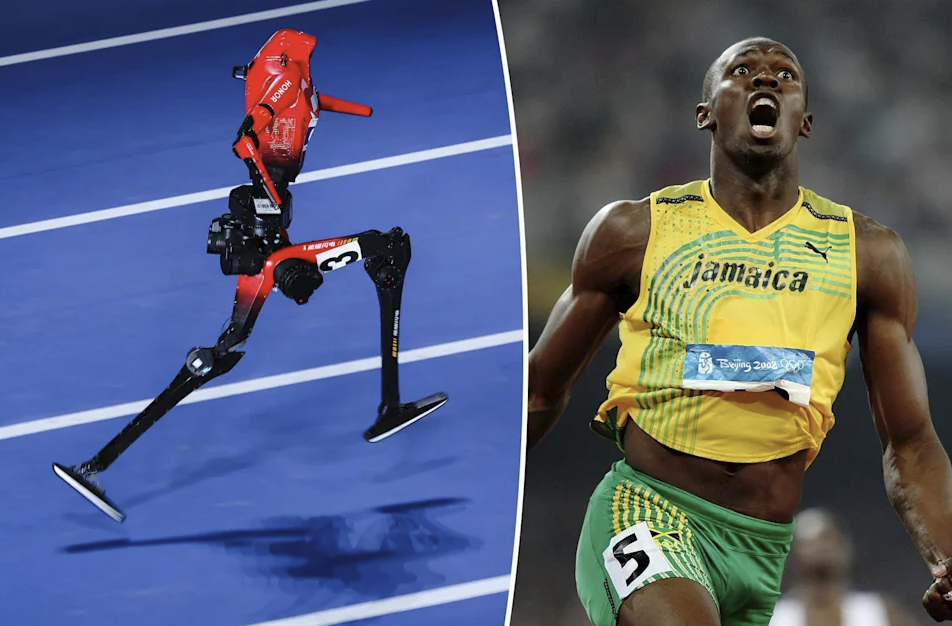
A Chinese robot set a new record at the opening of the second World Humanoid Robot Games in Beijing on Saturday, running 100 meters in 9.32 seconds during a preparatory test, faster than Usain Bolt’s long-standing world record.
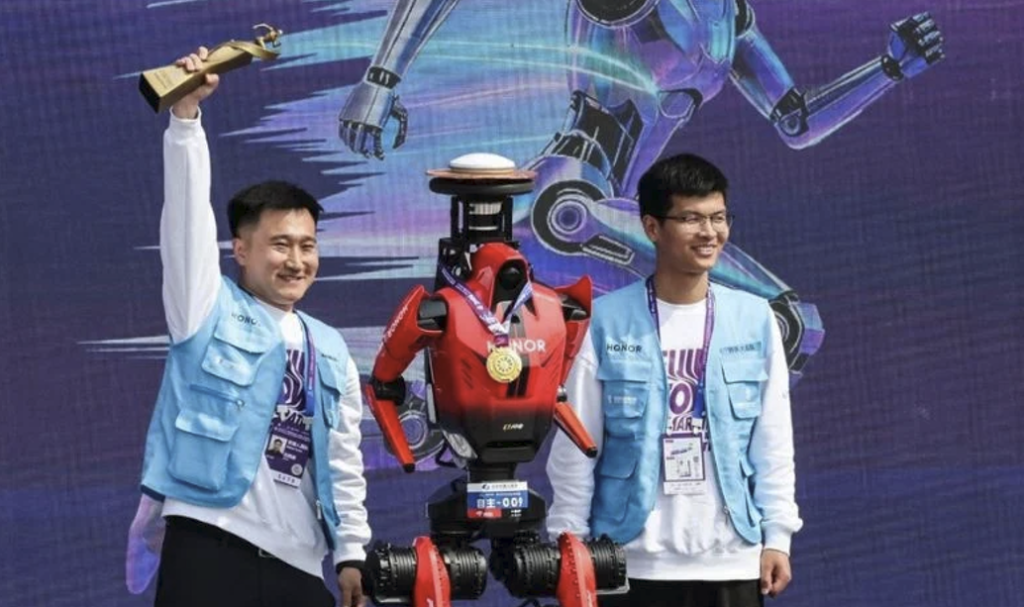
The event, part of a five-day games featuring more than 2,000 robots competing across 51 sporting events, saw the robot, named Lightning and developed by Chinese smartphone maker Honor, edge out Bolt’s 9.58-second mark set at the 2009 World Athletics Championships in Berlin, before finishing its official qualifying heat in 9.47 seconds.
A rival robot called Tiangong Ultra, built by the Beijing Humanoid Robot Innovation Center, won its own heat outright with a time of 9.39 seconds, also beating Bolt’s mark, after overtaking Lightning late in the race.
What Happened
Neither robot managed the graceful finish Bolt made famous when he set his record in 2009. Both machines plowed directly into a thick protective mat positioned at the finish line specifically to stop them, since the robots lack the ability to decelerate gradually the way a human sprinter can. Tiangong Ultra stumbled wildly into the sidelines after crossing the line, forcing nearby spectators to scramble out of the way, while Lightning collapsed to the ground and had to be carried off on a stretcher.
According to Chinese state broadcaster CCTV, Lightning reached a peak speed of 14.5 meters per second during its record-setting test run. Researchers had lengthened the robot’s legs by 10 centimeters ahead of the games, bringing them to 1.05 meters, after it stood 169 centimeters tall with 95-centimeter legs during an earlier half-marathon appearance in April, where it also beat the elite human world-record pace, finishing in 50 minutes and 26 seconds.
The performance marked a dramatic improvement from the inaugural edition of the games held in Beijing last year, when Tiangong Ultra won the 100-meter event in 21.50 seconds, nearly 12 seconds slower than Saturday’s results. This year’s games, running from August 22 to 26 at the National Speed Skating Oval built for the 2022 Winter Olympics, feature more than 2,000 humanoid robots competing in events ranging from sprinting and soccer to table tennis, dancing, and industrial task contests like medicine categorization.
Background
The World Humanoid Robot Games began in 2025 as the first event of its kind, drawing 280 teams from 16 countries to compete in sports including a 100-meter sprint that Tiangong won in 21.50 seconds, along with a 5-on-5 soccer final in which a Tsinghua University team defeated a German squad. At the closing ceremony of that first edition, organizers launched the World Humanoid Robot Sports Federation and confirmed Beijing would host a second edition the following August, setting up this year’s dramatically faster showing.
The games opened the same week Beijing hosted the separate 2026 World Robot Conference, where companies showcased approximately 3,000 products, including a wide range of humanoid robots, underscoring how central robotics has become to China’s broader technology and industrial strategy. Chinese policymakers and companies have increasingly promoted humanoid robots as a strategic emerging industry, betting that rapid advances in artificial intelligence and hardware will accelerate the technology’s real-world usefulness well beyond athletic exhibitions.
The spectacle arrives amid growing friction between the U.S. and China over robotics and artificial intelligence specifically. The Federal Communications Commission recently banned imports of Chinese humanoid robots, citing national security concerns, and the Pentagon separately added Unitree, one of China’s leading humanoid robot manufacturers, to a list of companies it says maintains ties to the Chinese military, allegations Beijing has firmly rejected.
Why It Matters
While a robot besting a human sprint record makes for an eye-catching headline, robotics experts caution against reading too much into the comparison, since Bolt’s achievement involved balance, endurance, and biological limits that a wheeled or mechanically optimized system doesn’t face in the same way, and the robots’ inability to stop gracefully highlights how far the technology remains from matching human athletic control in a more holistic sense. Even so, the rapid year-over-year improvement, from 21.50 seconds in the first games to under 9.5 seconds in the second, illustrates just how quickly Chinese robotics developers are iterating on speed and mobility engineering.
The broader context matters as much as the individual result. China has increasingly positioned events like this as public demonstrations of its robotics ambitions, timed deliberately alongside major industry conferences, at a moment when Washington has taken concrete regulatory and defense-related steps to limit the reach of Chinese humanoid robot manufacturers in the U.S. market. The juxtaposition, a flashy sports spectacle unfolding just as American regulators restrict imports of the very machines on display, reflects how thoroughly humanoid robotics has become entangled with broader U.S.-China technological competition.
Statistics & Context
- Lightning’s preparatory test time: 9.32 seconds
- Lightning’s official qualifying heat time: 9.47 seconds
- Tiangong Ultra’s winning heat time: 9.39 seconds
- Usain Bolt’s human world record, set in 2009: 9.58 seconds
- Lightning’s peak speed during its record run: 14.5 meters per second
- Robots participating in this year’s games: more than 2,000
- Total events at the games: 51, spanning more than 1,000 individual competitions
- Tiangong Ultra’s 100m time at last year’s inaugural games: 21.50 seconds
- Games duration: August 22 to 26, 2026
What’s Next
The five-day games continue through August 26, with hundreds of additional events still scheduled across categories including soccer, dancing, and various industrial task competitions designed to showcase practical robot capabilities beyond athletics. Given the pace of improvement between this year’s games and last year’s inaugural edition, robotics researchers and industry watchers are likely to pay close attention to whether Chinese manufacturers continue posting sharp year-over-year gains ahead of a potential third edition. The ongoing U.S. regulatory scrutiny of Chinese humanoid robot makers is also expected to remain a live issue as the technology continues advancing rapidly on the world stage.
FAQ
How fast did the robot run compared to Usain Bolt?
The robot Lightning ran 100 meters in 9.32 seconds during a preparatory test, faster than Bolt’s 9.58-second world record set in 2009. Its official qualifying heat time was 9.47 seconds.
Which robot actually won its race?
Tiangong Ultra, built by the Beijing Humanoid Robot Innovation Center, won its heat outright with a time of 9.39 seconds after overtaking Lightning late in the race.
Could the robots stop like a human sprinter?
No. Both robots ran directly into a protective mat at the finish line since they lack the ability to decelerate gradually, with one stumbling into the sidelines and the other collapsing and needing to be carried off on a stretcher.
How many robots are competing in the games?
More than 2,000 humanoid robots are taking part across 51 events and more than 1,000 individual competitions.
Is this the first time these games have been held?
No. This is the second edition, following an inaugural event in Beijing in August 2025 that drew 280 teams from 16 countries.
Editorial Note: This article was prepared using publicly available information from news organizations and Chinese state media reporting available at the time of publication.
Sources:
Fox News: Chinese humanoid robot breaks Usain Bolts 100m dash record at 9.39 seconds
Reuters via Yahoo News: Chinese humanoid robot Lightning beats Usain Bolts 100m world record at Beijing games
ABC News Australia: Chinese humanoid robot beats Usain Bolts 100 metres world record