
Quick Summary
VAR, short for Video Assistant Referee, is the technology soccer uses to review controversial calls involving goals, penalties, red cards, and mistaken identity. Despite being designed to eliminate human error, it has become one of the most contested features in modern soccer, reigniting fierce debate after Folarin Balogun’s red card ejection cost the United States its top scorer for the World Cup round of 16. This explainer breaks down how VAR actually works, why it keeps generating outrage, and why decisions like the one against Balogun cannot be appealed.
What It Is
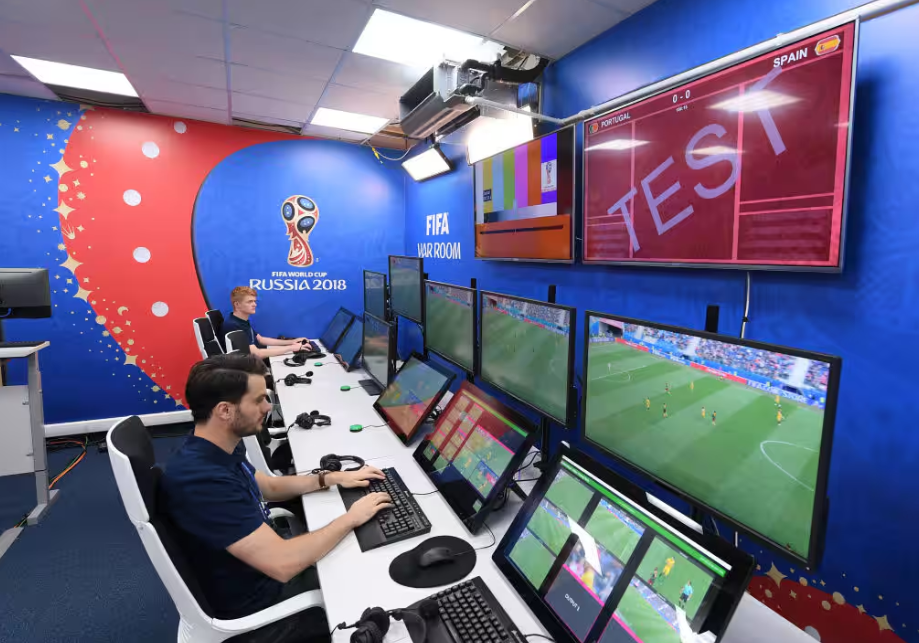
VAR is a video review system that supports the on-field referee by checking for clear and obvious errors in four specific match-changing situations: goals, penalty decisions, red cards, and cases of mistaken identity. A dedicated team, the video assistant referee and three assistant VARs, watches every moment of a match from a centralized video operation room, cross-checking incidents against multiple camera angles without interrupting play unless something meets the threshold for review.
At the 2026 World Cup, that video operation room is based in Doha, Qatar, receiving live feeds from all eight host stadiums through a fiber-optic network. The VAR team has access to 42 broadcast cameras, including eight super slow-motion and four ultra slow-motion feeds, giving officials far more visual information than any single referee on the field could possibly process in real time.
Background: How a Review Actually Happens
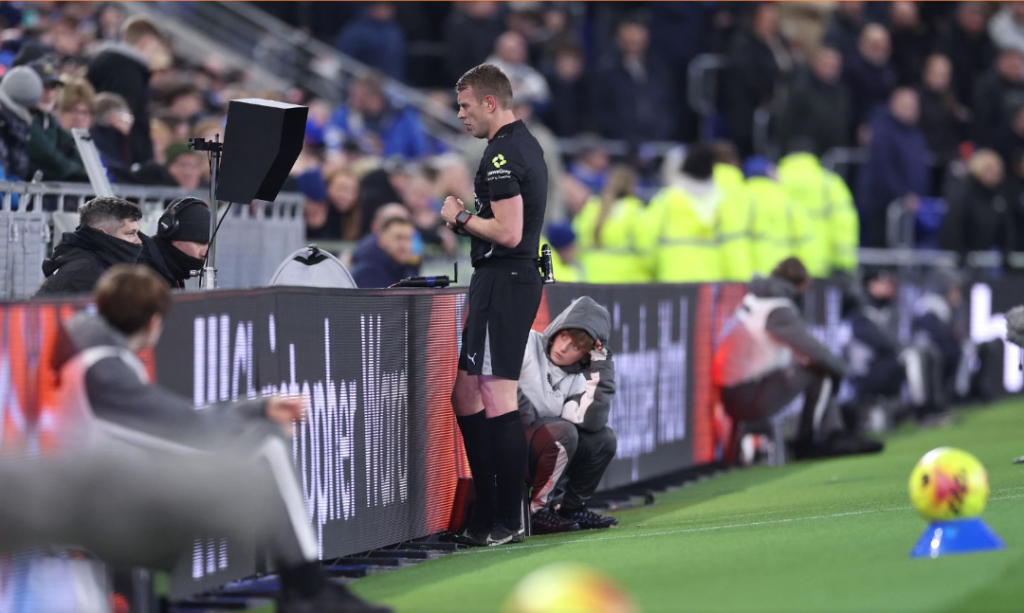
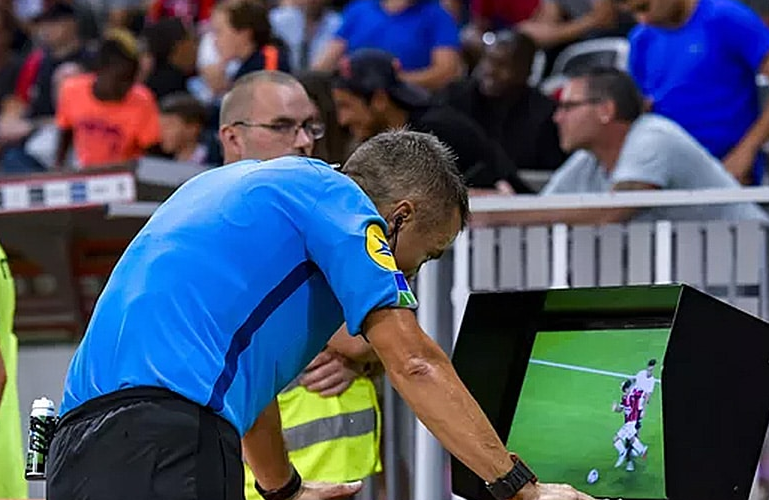
When the VAR team identifies a potential error, they alert the on-field referee, who can then choose to review the incident on a pitchside monitor before making a final call. Slow-motion replays are used specifically for factual determinations, such as the precise point of contact in a physical foul or whether a player was in an offside position. Normal-speed footage, by contrast, is used to judge the intensity or seriousness of an offense, since slow motion can make routine contact appear more violent than it actually was in real time.
That distinction is central to understanding why decisions like the one against Balogun generate so much controversy. Former Premier League referee Andy Davies has explained that VAR’s greatest strength, giving officials multiple angles and replay speeds, can also become its greatest weakness when slow-motion footage makes an accidental, low-intensity challenge look more dangerous than it appeared at full speed.
Why It Matters
The system operates under a principle known as “minimal interference, maximum benefit,” meaning VAR is only supposed to intervene when there is little or no doubt the referee made a clear mistake, not simply because a decision could reasonably have gone either way. In practice, where that line falls has proven to be one of the most persistently divisive questions in modern soccer. A Sky Sports fan poll found that only 4 percent of respondents believed VAR was working “very well,” while 60 percent rated its performance as either “rather badly” or “very badly.”
Crucially, once a referee makes a subjective decision after reviewing the pitchside monitor, that decision is final. FIFA’s 2026 World Cup regulations state explicitly that referee decisions on facts connected with play “are final and not subject to appeal.” This is precisely the rule that prevented the United States from contesting Folarin Balogun’s red card against Bosnia-Herzegovina, a decision multiple pundits, including Davies, described as an unfortunate accident rather than a deliberate act of foul play.
Expert Analysis
Consistency impact: One of the most common complaints about VAR is inconsistent application, with similar-looking challenges receiving different outcomes across different matches. Balogun’s dismissal was compared directly by USMNT coach Mauricio Pochettino to a similar incident involving Lionel Messi against Algeria earlier in the same tournament that did not result in a card, illustrating exactly this kind of perceived inconsistency.
Competitive impact: Because red card decisions trigger automatic suspensions with no appeal process for the underlying call, VAR-driven dismissals can directly reshape a team’s tournament trajectory, as seen with the United States now facing Belgium in the round of 16 without its leading scorer.
Trust impact: Research published in Applied Sciences found that VAR reduces certain error rates by roughly 80 percent according to some referee assessments, yet fan trust in the system has not risen proportionally, suggesting the technology’s technical accuracy and its perceived fairness are not the same thing.
Institutional impact: FIFA’s disciplinary panel retains the separate authority to extend suspensions beyond the automatic one-match ban in serious cases, as it did with Qatar’s Assim Madibo earlier in the tournament, meaning teams can still appeal the length of a punishment even when the underlying red card itself cannot be contested.
Statistics & Context
VAR was first used at a major tournament during the 2018 World Cup in Russia. At the 2026 World Cup, the system uses 42 broadcast cameras feeding into a centralized video operation room in Doha. A Sky Sports poll found only 4 percent of fans rated VAR as working “very well,” while a combined 60 percent rated its performance negatively. Balogun’s red card was the 12th issued at the 2026 tournament, all of them straight reds rather than second-yellow dismissals.
What’s Next
VAR is expected to remain a fixture of top-level soccer for the foreseeable future, with FIFA and the International Football Association Board continuing to refine its protocols, including a new 2026 rule allowing referees to review certain fouls before play resumes. Whether those refinements meaningfully reduce controversy, or simply shift where the next disputed decision occurs, remains an open question that will likely resurface with the tournament’s next contested red card.
FAQ
Can VAR decisions ever be appealed?
No. Once a referee makes a final decision after a VAR review, FIFA’s World Cup regulations state that decision is not subject to appeal, though teams can separately appeal if FIFA’s disciplinary panel later extends a suspension beyond the automatic minimum.
Why does VAR use slow motion for some decisions and normal speed for others?
Slow motion is used for factual questions, like where contact occurred or a player’s position, while normal speed is used to judge the intensity or seriousness of an offense, since slow motion can distort how forceful a challenge actually appeared in real time.
Do fans generally support VAR?
Survey data suggests otherwise. A Sky Sports poll found only 4 percent of fans believed VAR was working very well, while a majority rated its performance negatively.
Who actually makes the final call, the referee or the VAR team?
The on-field referee always makes the final decision. The VAR team can only recommend a review; the referee can accept, reject, or reverse their original call after watching the replay.
Has VAR reduced the number of officiating errors?
Some data suggests meaningful improvement. One French Ligue 1 referee estimated VAR reduces the overall error percentage on the order of 80 to 20, though critics argue technical accuracy hasn’t translated into greater fan trust in individual decisions.
Editorial Note: This article was prepared using publicly available information from international news organizations and official sources available at the time of publication. Facts may be updated as authorities release new information.
Sources: