
Quick Summary
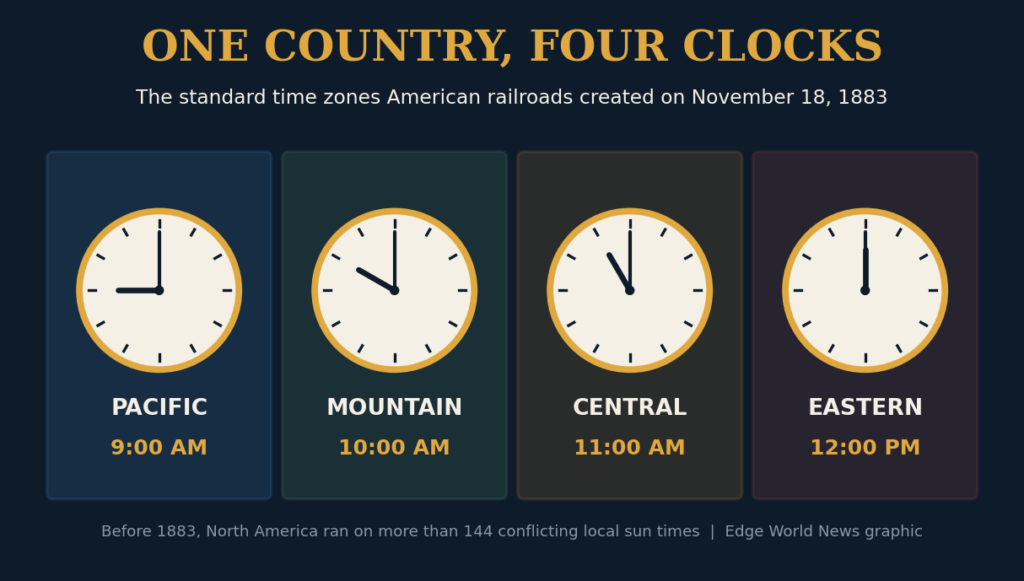
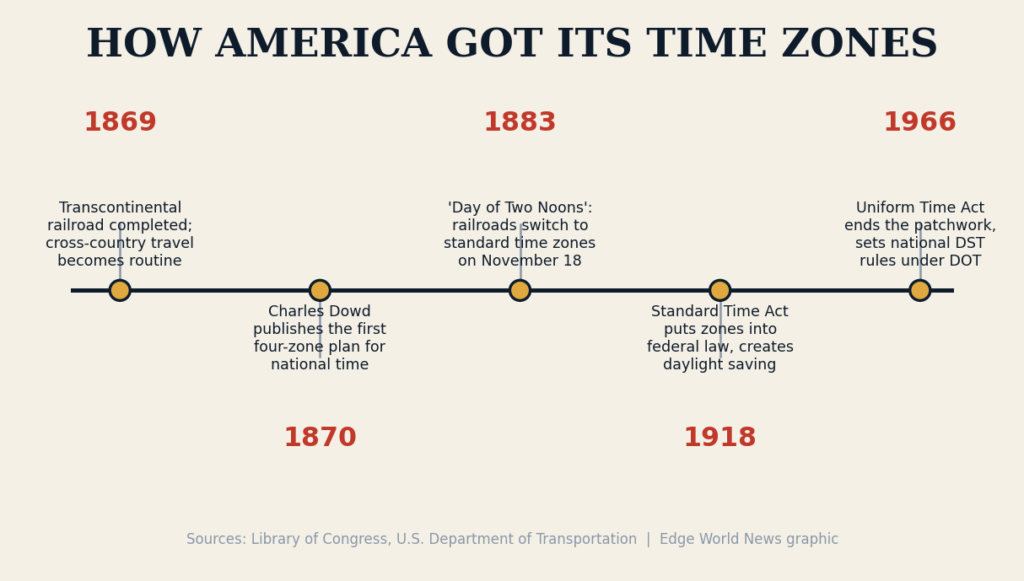
America runs on four main time zones today because the railroad industry invented standard time in 1883, decades before the federal government got involved. Before that year, time in the United States was a local affair, with more than 144 different sun-based times in use across North America and roughly 80 competing railroad timetables by the early 1880s. On November 18, 1883, a date remembered as the “Day of Two Noons,” railroads across the country reset their clocks to four coordinated zones, Eastern, Central, Mountain and Pacific, and most American cities followed within a year. Congress did not write the system into federal law until the Standard Time Act of 1918, and the modern rules Americans live under were not settled until the Uniform Time Act of 1966. The story explains why your phone changes time when you cross from Chicago to Denver, and why a private industry, not Washington, drew the lines that still govern American life.
What Standard Time Actually Is
Standard time is the idea that everyone within a wide geographic band agrees to set their clocks to the same hour, anchored to a meridian of longitude, rather than to the position of the sun over their own town. The continental United States uses four such bands, based on the mean solar time at the 75th, 90th, 105th and 120th meridians west of Greenwich, each exactly one hour apart. Counting Alaska, Hawaii and the territories, the country officially spans nine time zones, from the Chamorro zone in Guam to the Atlantic zone in Puerto Rico. The boundaries look natural on a map today, but nothing about them was inevitable. They were drawn in the 1880s by a railroad guide publisher named William F. Allen, and they have shifted only modestly since.
A Nation Running on Sun Time
For most of the 19th century, every American community kept its own time. A town would set its clocks by the moment the sun crossed the local meridian, and a trusted public clock, often on a church steeple or in a jeweler’s window, served as the reference for everyone else. When travel meant days on horseback, nobody cared that noon in Boston arrived several minutes before noon in New York. The railroads destroyed that comfortable arrangement. After the Pacific Railway Act of 1862 funded the transcontinental line, track mileage exploded, reaching an estimated 35,000 miles by 1865, and journeys that once took months shrank to hours. According to the Library of Congress, North America was a patchwork of more than 144 local times, and even after railroads consolidated their schedules around the clocks of major hub cities, about 80 different railroad time standards remained in use by the early 1880s. Stations displayed multiple clocks, one for each railroad they served, none agreeing with the town clock outside. Charles F. Dowd, the Yale-educated school principal who first proposed a four-zone national system in 1870, described the traveler’s watch as “a delusion,” baffled by station clocks “defiant of harmony either with one another or with surrounding local time.”
Dowd was not alone. Sandford Fleming, chief engineer of Canada’s government railways, proposed a worldwide 24-hour standard in 1876, and meteorologist Cleveland Abbe pushed the American Meteorological Society to back standardized time in 1879 because weather forecasting depended on synchronized observations. Facing public pressure and fearing that Congress might impose a solution, the railroads acted first. In October 1883, the General Time Convention, the industry’s coordinating body, met at the Grand Pacific Hotel in Chicago and approved a plan drafted by its secretary, William F. Allen, who had blended the ideas of Dowd, Fleming and Abbe with practical input from railroad engineers.
The Day of Two Noons
At noon on Sunday, November 18, 1883, telegraph signals from the U.S. Naval Observatory and the Allegheny Observatory in Pittsburgh synchronized railroad clocks across the continent. In cities east of the new zone meridians, the clock struck noon twice that day, once on old local time and again minutes later on the new standard, which is how the date earned its nickname. Newspapers printed conversion instructions and zone maps, railroad officials lobbied city councils, and most cities adopted the new time immediately or within the following year. Not everyone welcomed it. The Indianapolis Sentinel complained that people would now have to “marry by railroad time and die by railroad time,” and predicted the sun, moon and stars would be ordered to comply as well. The sarcasm aged poorly. Standard time worked, and it stuck.
Why a 143-Year-Old Decision Still Shapes Your Day
Every flight you book, every conference call you schedule across the country, every kickoff time listed as “1 p.m. ET, 10 a.m. PT” traces back to the framework the railroads built. Congress finally codified the zones in the Standard Time Act of 1918, which also created daylight saving time and handed boundary authority to the Interstate Commerce Commission. Wartime brought year-round daylight saving between 1942 and 1945, and the chaos that followed, when states and even individual cities set their own daylight rules, prompted the Uniform Time Act of 1966, which put the Department of Transportation in charge and set the national clock-change calendar still in use. That law is also why Arizona and Hawaii can lawfully sit out daylight saving while their neighbors spring forward.
The Numbers Behind the Story
More than 144 local sun times existed in North America before standardization, according to the Library of Congress. Roughly 80 railroad time standards were still competing in the early 1880s. The 1883 plan anchored zones to 4 meridians, each 15 degrees and one hour apart. Federal law caught up 35 years later, in 1918, and the modern daylight saving framework arrived 83 years after the Day of Two Noons, in 1966. Today the United States and its territories span 9 time zones.
Where the Debate Goes From Here
The system the railroads built is stable, but the clock-change rules layered on top of it remain contested. The House voted this week to make daylight saving time permanent nationwide, a change that would not redraw the zones but would shift every winter sunrise an hour later. Whatever the Senate decides, the underlying geography of American time, four bands drawn by a railway guide publisher in 1883, is likely to outlive us all.
Read also: Darline Graham Nordone Takes Lindsey Graham’s Senate Seat
FAQ
Who invented time zones in the United States?
School principal Charles Dowd proposed the first four-zone plan in 1870, Canadian engineer Sandford Fleming pushed an international standard, and railroad official William F. Allen designed the system actually adopted in 1883.
When did US time zones become law?
The railroads adopted them privately on November 18, 1883, but Congress did not make them federal law until the Standard Time Act of March 1918.
How many time zones does the United States have?
Nine in total: Eastern, Central, Mountain, Pacific, Alaska, Hawaii-Aleutian, Atlantic, Samoa and Chamorro. The contiguous 48 states use the first four.
What was the Day of Two Noons?
November 18, 1883, when cities reset clocks to railroad standard time at midday, so the clock effectively struck noon twice, once on old local time and once on the new standard.
Why don’t Arizona and Hawaii change their clocks?
The Uniform Time Act of 1966 lets states exempt themselves from daylight saving time. Both states opted out, so they stay on standard time all year.
Editorial Note: This article was prepared using publicly available information from international news organizations and official sources available at the time of publication. Facts may be updated as authorities release new information.
Sources: