
Quick Summary
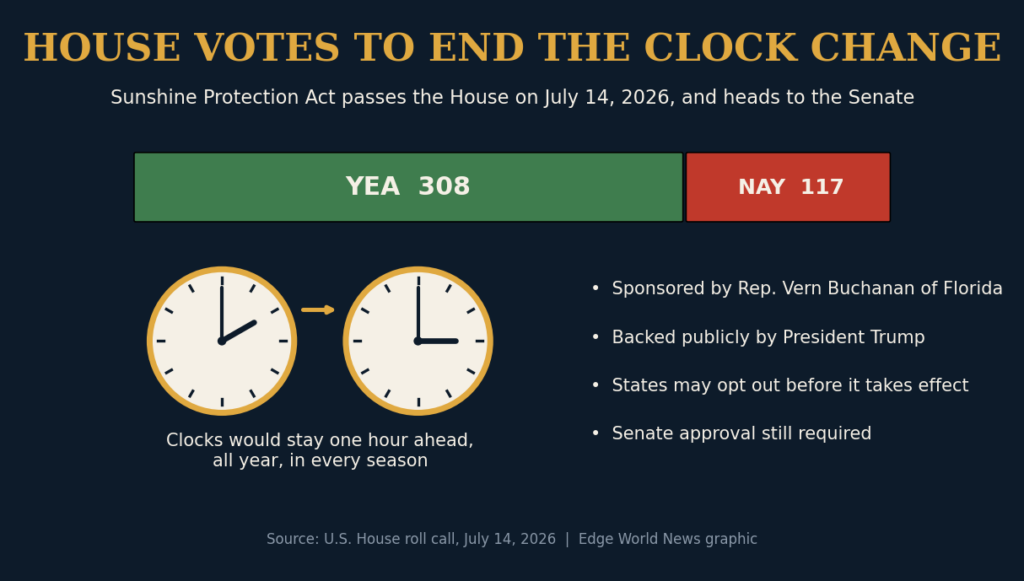
Daylight saving time moved one major step closer to becoming permanent on Tuesday, when the House passed the Sunshine Protection Act by a vote of 308 to 117, a bill that would end the twice-yearly clock change for most Americans. The measure, sponsored by Republican Representative Vern Buchanan of Florida and publicly backed by President Trump, would lock the country onto the time currently observed from March to November, with states allowed to exempt themselves before the law takes effect. The bill now heads to the Senate, where its fate is far less certain. Several senators from both parties have opposed it in committee, and sleep medicine organizations continue to argue that Congress is picking the wrong clock, warning that permanent daylight saving would push winter sunrises past 8:30 or even 9 a.m. across much of the northern United States. The last time the country tried this, in 1974, public support collapsed within months and Congress reversed itself before the first year was out.
What Happened on Tuesday
The House vote on July 14 was decisively bipartisan, with 308 members supporting the bill against 117 opposed, according to reporting from NBC News and The Washington Post. Buchanan, whose home state of Florida passed its own permanent daylight saving law back in 2018 that has sat dormant awaiting federal approval, has pushed versions of the Sunshine Protection Act for years. What changed this time was presidential muscle. Trump has repeatedly urged Congress to “lock the clock,” and his public endorsement helped move a bill that had stalled in previous sessions. Opposition came disproportionately from lawmakers representing Midwestern and northern-tier states, where the geography of permanent daylight saving bites hardest: the western edges of time zones would see the latest winter sunrises in the country.
How the Law Would Work
The Sunshine Protection Act does not abolish time zones or touch the underlying standard time framework that has governed American clocks since 1918. Instead, it would make the daylight saving schedule, currently observed from the second Sunday in March to the first Sunday in November, the year-round national time. States that prefer not to participate could opt out before the act takes effect, similar to the exemption Arizona and Hawaii already use to stay on permanent standard time under the Uniform Time Act of 1966. In practical terms, nothing would change about summer. Winters would feel different: an extra hour of light in the late afternoon, purchased with an extra hour of darkness in the morning.
Why It Matters
Americans consistently tell pollsters they hate changing their clocks, and the disruption is not just an annoyance. Researchers have linked the springtime shift to short-term increases in heart attacks, workplace injuries and car crashes. The disagreement in Washington has never been about whether to stop switching. It is about which time to keep. The American Academy of Sleep Medicine, the American Medical Association and the National Sleep Foundation have all endorsed permanent standard time instead, arguing that morning light is what anchors the human circadian clock and that permanently shifted evenings would leave the body chronically misaligned. Senator Tom Cotton of Arkansas has made the same case in blunter terms, warning that the bill would produce “absurdly late” winter sunrises and force children to walk to school “in the pitch black” across much of the country.
The Ghost of 1974
Congress has run this experiment before, and the history hangs over the current debate. In January 1974, responding to the oil crisis, President Nixon signed a two-year trial of year-round daylight saving time, promising energy savings equivalent to roughly 150,000 barrels of oil a day. Public support stood at 79 percent when the trial began. After one dark winter, it had fallen to 42 percent, according to polling cited by NPR. Lawmakers pointed to the deaths of eight Florida schoolchildren in pre-dawn accidents, and the Department of Transportation found the energy savings were minimal at best. President Ford signed the repeal in October 1974, less than ten months after the experiment began. Supporters of the current bill argue that modern life has changed, with more flexible work schedules and far less reliance on children walking to school in the dark. Skeptics respond that the sun has not changed at all.
By the Numbers
The House passed the bill 308 to 117 on July 14, 2026. The 1974 experiment saw approval collapse from 79 percent to 42 percent in a single winter. Under permanent daylight saving, early-January sunrises would arrive around 8:20 a.m. in New York and Chicago, close to 9 a.m. in Detroit and parts of Minnesota, and after 9 a.m. at the western edges of some zones. Two states, Arizona and Hawaii, already keep one time all year, and about 20 states have passed conditional laws or resolutions favoring a permanent clock, most of them contingent on exactly the kind of federal action the House just took.
What Happens Next
The bill moves to the Senate, where the path is narrow. Senators from both parties opposed the companion measure in committee, and some have asked leadership not to schedule a floor vote at all. If the Senate passes it and Trump signs it, the law would take effect after a transition window during which states could file their exemptions, setting up a state-by-state scramble that could redraw the country’s time map more dramatically than anything since 1966. If the Senate stalls, Americans will keep springing forward and falling back, and this bill will join a long list of Sunshine Protection Acts that died in the upper chamber.
FAQ
Did the House really vote to end the clock change?
Yes. On July 14, 2026, the House passed the Sunshine Protection Act, 308 to 117. It is not law yet; the Senate must still pass it and the president must sign it.
Would this mean more sunlight?
No. The amount of daylight stays the same. Permanent daylight saving time only shifts the clock so that an hour of morning light moves to the evening, which matters most in winter.
When would clocks stop changing?
Only after the Senate passes the bill and the president signs it, followed by a transition period during which states can opt out. No date is set, and the Senate has blocked similar bills before.
Why do doctors oppose it?
Sleep medicine groups favor permanent standard time, not permanent daylight saving, because morning light regulates the body’s internal clock. They warn of chronic misalignment, worse sleep and long-term health effects.
Has America tried this before?
Yes, in 1974 under President Nixon. Support collapsed after one winter of dark school-morning commutes, and Congress repealed it within the year.
Read also : Why Does the American Flag Have 13 Stripes and 50 Stars? The Real History Behind Old Glory
Editorial Note: This article was prepared using publicly available information from international news organizations and official sources available at the time of publication. Facts may be updated as authorities release new information.
Sources:
- NBC News, House passes Trump-backed bill that would make daylight saving time permanent
- The Washington Post, House passes Trump’s plan to make daylight saving time permanent
- NPR, The U.S. tried permanent daylight saving time in the 1970s, then quickly rejected it
- The Hill, If permanent daylight saving time bill passes, would your state be impacted?
- American Academy of Sleep Medicine, House committee advances Sunshine Protection Act