
Quick Summary
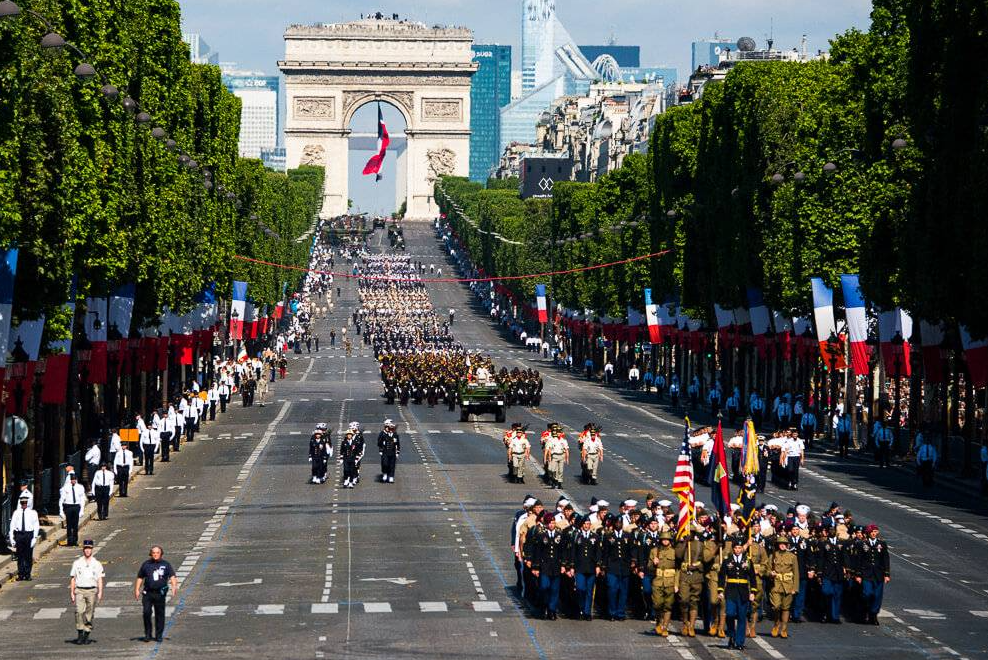
France marked Bastille Day 2026 with its most politically charged military parade in years, as President Macron hosted around 30 heads of state and government, including Ukrainian President Volodymyr Zelenskyy, in what officials described as a message to both Russian President Vladimir Putin and U.S. President Donald Trump that Europe is united and stepping up to defend itself. Roughly 7,600 troops marched down the Champs-Élysées, a record for the event, with contingents from multiple allied nations taking part in a break from the parade’s tradition of typically inviting only one foreign country each year. It was Macron’s final Bastille Day parade before he steps down next year at the end of his second term.
What Happened
The parade opened with about 500 troops from the “coalition of the willing,” a grouping of mostly European nations that have pledged support for Ukraine’s postwar security, followed symbolically by roughly 25 Ukrainian soldiers marching just behind them. Ukrainian troops received the loudest cheers of the day from crowds lining the historic route between the Arc de Triomphe and the Place de la Concorde. Two Ukrainian co-pilots, trained in France, flew alongside French air force pilots aboard Mirage 2000B fighter jets during the aerial flyover, which also included aircraft from Germany, the UK, Croatia, Poland, Denmark, Greece, Sweden, Norway, Spain, and Italy.
British troops took part in the parade for the first time in roughly 20 years, marching in a symbolic gesture of unity alongside outgoing UK Prime Minister Keir Starmer, who was attending one of his final foreign engagements before stepping down. German Chancellor Friedrich Merz was also among the leaders in the viewing stand alongside Macron and Zelenskyy.
Background
Bastille Day marks the anniversary of the 1789 storming of the Bastille fortress and prison in Paris, the event that helped ignite the French Revolution. It has remained central to French national identity ever since, with the Paris parade beneath the Arc de Triomphe serving as its centerpiece each year. The event famously inspired Trump to stage his own military parade after attending as Macron’s guest of honor during the 2017 celebration in his first term.
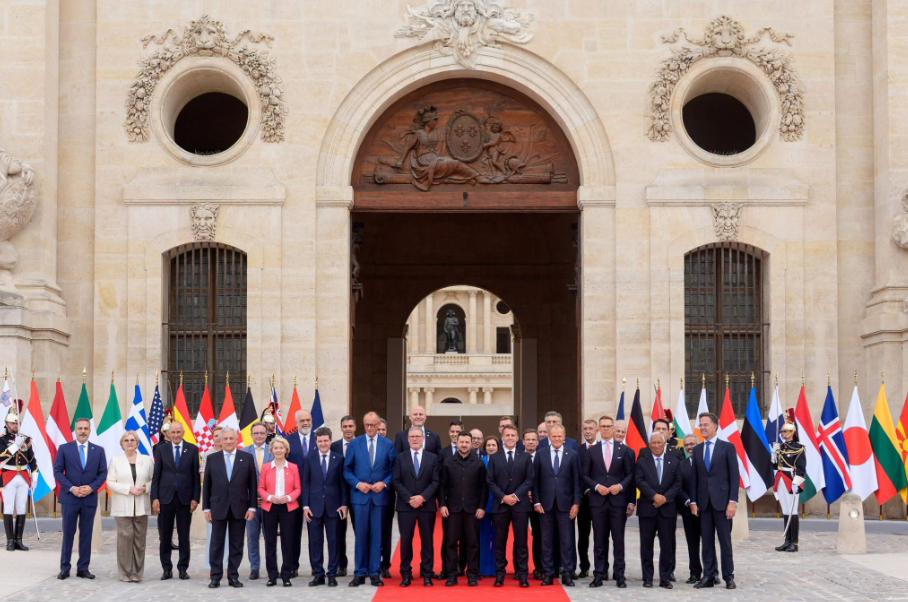
This year’s parade followed directly on the heels of a Monday summit at Les Invalides, where European leaders and Ukraine’s government announced the creation of an Integrated Anti-Ballistic Missile Coalition involving nine European countries, France, Britain, Germany, Italy, Denmark, the Netherlands, Norway, Spain, and Sweden, working on a planned missile-defense system called Freyja that draws on lessons from Ukraine’s wartime experience. Major European defense contractors including Thales, Saab, Leonardo, and MBDA were represented at the coalition’s first meeting.
Why It Matters
The scale and staging of the parade, coming a decade after the 2016 Bastille Day truck attack in Nice that killed 86 people, was designed to project something beyond ceremony: a deliberate signal of European military “strategic autonomy” at a moment when the continent’s future security relationship with both the U.S. and Russia remains uncertain. A French presidential official said the display was meant to illustrate France’s rearmament and a broader European strategic awakening, while Deputy Defence Minister Alice Rufo said it showed a Europe united and confident in itself.
For Zelenskyy, the recognition carried direct symbolic weight, as he described the Ukrainian troops’ presence as a genuine acknowledgment of his country’s strength and the strength of its armed forces. For Macron, hosting the parade as his final one before leaving office next year gave him a capstone moment for a presidency that has repeatedly pushed for greater European defense spending and deeper cooperation among allies.
Expert & Official Reaction
French government framing: Deputy Defence Minister Alice Rufo told RTL radio that what marched past was a Europe united and determined to support Ukraine against Russia, a Europe confident in itself.
Macron’s own remarks: In his traditional address to the armed forces, Macron said Europe cherishes freedom and the rule of law and stands ready to fight to defend them, adding separately that Europe would fight for its freedom even if it required its own troops shedding blood.
Ukrainian reaction: Zelenskyy said the participation of Ukrainian troops was a true recognition of Ukraine’s strength and the strength of its armed forces.
Allied soldier’s perspective: A 21-year-old British soldier marching in the parade said being there and marching alongside Ukrainian troops would help build better ties with NATO and be part of that history.
Statistics & Context
- Troops marching this year: approximately 7,600, up from 5,810 in 2025, a record
- World leaders hosted by Macron: around 30
- Ukrainian troops marching symbolically behind the coalition contingent: about 25
- Aircraft, helicopters, and vehicles involved (per Euronews figures): 98 aircraft, 31 helicopters, 315 vehicles
- European countries in the new Integrated Anti-Ballistic Missile Coalition: 9 (France, UK, Germany, Italy, Denmark, Netherlands, Norway, Spain, Sweden)
- Years since British troops last joined the parade: approximately 20
- Deaths in the 2016 Nice Bastille Day truck attack, marked on its 10th anniversary this year: 86
What’s Next
The newly announced Integrated Anti-Ballistic Missile Coalition is expected to move toward establishing common military requirements, technical working groups, and a roadmap for an initial operational capability in the coming months. With both Macron and Starmer nearing the end of their terms in office, questions remain about how the coalition-building momentum on display in Paris will be sustained under their successors, particularly as the war in Ukraine and Europe’s broader defense posture toward Russia continue to evolve.
FAQ
Why was this year’s Bastille Day parade different?
Macron hosted around 30 world leaders and broke from tradition by inviting troops from multiple allied nations to march together, rather than the usual single guest country, in a display of support for Ukraine.
How many troops marched in the parade?
Approximately 7,600, a record for the event, up from 5,810 the previous year.
Was Zelenskyy at the parade?
Yes. Ukrainian President Volodymyr Zelenskyy watched from the viewing stand alongside Macron, and around 25 Ukrainian troops marched in the parade, receiving the loudest cheers of the day.
What is the Integrated Anti-Ballistic Missile Coalition?
A newly announced European missile-defense initiative involving nine countries, France, the UK, Germany, Italy, Denmark, the Netherlands, Norway, Spain, and Sweden, working on a system called Freyja that draws on Ukraine’s combat experience.
Why is this Macron’s last Bastille Day parade?
He is set to step down next year after serving the maximum two consecutive terms allowed as French president.
Editorial Note: This article was prepared using publicly available information from international news organizations and official sources available at the time of publication. Facts may be updated as authorities release new information.
Sources:
France 24 – France’s Bastille Day parade showcases European support for Ukraine
ABC News – European troops join Paris Bastille Day parade in show of unity for Ukraine