
Quick Summary
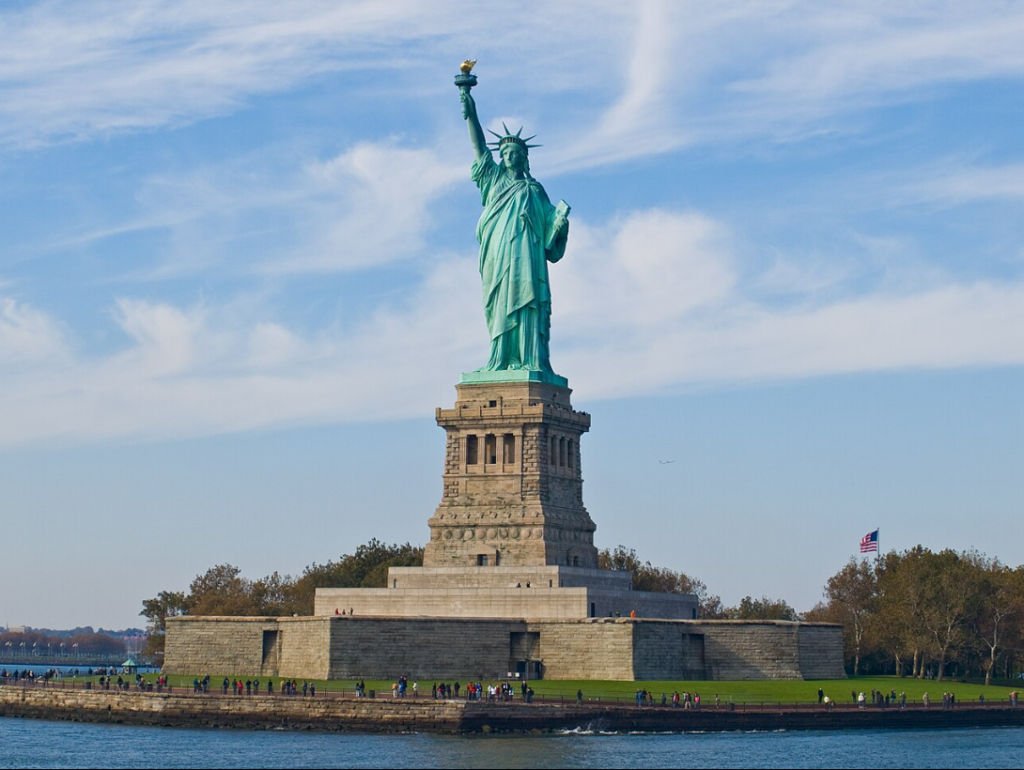
Lady Liberty was a gift from France to America, but the story behind the Statue of Liberty is far richer, stranger, and more political than the friendly postcard version most people know. The idea was born at a French dinner party in 1865, the statue took over two decades to finance and build, its iron skeleton was engineered by the same man who built the Eiffel Tower, and the pedestal it stands on was paid for largely by ordinary Americans donating pennies through a newspaper campaign. When President Grover Cleveland dedicated the monument on October 28, 1886, he was accepting not just a work of art but a 225-ton argument about what both nations wanted democracy to mean.
Where the Idea Came From
The story begins in the summer of 1865 at the home of Édouard de Laboulaye, a French legal scholar, historian, and prominent abolitionist. The American Civil War had just ended, slavery had been abolished, and Laboulaye, a devoted admirer of the American experiment, proposed that France should present the United States with a monument celebrating the centennial of American independence in 1876 and the survival of its democracy.
There was a domestic motive too. France in 1865 was ruled by Emperor Napoleon III, and political liberty at home was in short supply. For Laboulaye and his circle of liberal reformers, a colossal monument to freedom in New York Harbor would double as a pointed message to their own government. Honoring American liberty was, in part, a way of demanding French liberty.
Among the guests absorbing this idea was a young Alsatian sculptor named Frédéric Auguste Bartholdi. He had already dreamed of building something colossal, having earlier proposed a giant robed woman holding a lamp for the entrance of Egypt’s Suez Canal. That project never happened, but the vision found a new home. By 1870 Bartholdi had produced sketches of a robed female figure lifting a torch, and after touring the United States in 1871 he settled on the perfect site: Bedloe’s Island, a small speck in New York Harbor that every ship entering the busiest port in America had to pass.
How the Statue Was Actually Built
The formal arrangement was elegant: France would pay for the statue, and America would pay for the pedestal. The French side raised roughly 400,000 francs through public donations, lotteries, and benefit events, with contributions coming from schoolchildren, villages, and ordinary citizens rather than the government.
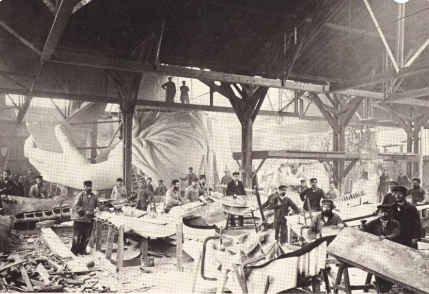
Bartholdi’s design, formally titled “Liberty Enlightening the World,” was a marvel of 19th-century engineering. The statue’s skin consists of hammered copper sheets about the thickness of two pennies, shaped by hand in a Paris workshop. Holding up 151 feet of thin copper against Atlantic winds required a revolutionary solution, and it came from Gustave Eiffel, who joined the project in 1879, several years before he built his famous tower. Eiffel designed an internal iron pylon with a flexible secondary skeleton that lets the copper skin expand, contract, and sway independently, essentially a curtain-wall system decades ahead of its time.
The completed statue, 151 feet tall and weighing 225 tons, was formally presented to the American ambassador in Paris on July 4, 1884. It was then disassembled into 350 pieces, packed into 214 crates, and shipped across the Atlantic aboard the French frigate Isère, arriving in New York in June 1885 to a harbor full of cheering boats.
The Pedestal Problem, and How a Newspaper Solved It
There was one embarrassing catch: America had not finished paying for the pedestal. Fundraising had stalled, Congress declined to help, and the governor of New York vetoed state funding. The crated statue sat in storage while other cities, including Boston and Philadelphia, offered to take it.
Enter Joseph Pulitzer, the Hungarian-born publisher of the New York World. In March 1885 he launched a front-page campaign scolding the wealthy for their stinginess and promising to print the name of every donor, no matter how small the gift. The response was extraordinary. More than 120,000 people contributed about $102,000 in five months, most giving less than a dollar. Children mailed in coins, and one group of kids sent a dollar they had saved to buy circus tickets. The campaign finished the pedestal, designed by architect Richard Morris Hunt, and cemented the idea that the monument belonged to ordinary Americans.
What the Statue Really Symbolizes
The popular image of Lady Liberty as the welcoming mother of immigrants came later. Bartholdi and Laboulaye’s original symbolism was about law and liberty: the tablet in her left arm bears the date July 4, 1776, the seven rays of her crown represent the seven seas and continents, and at her feet lies a broken shackle and chains, a deliberate reference to the abolition of slavery that many visitors never see from the ground.
The immigrant symbolism grew organically. Emma Lazarus wrote her sonnet “The New Colossus,” with its famous lines about “your tired, your poor, your huddled masses yearning to breathe free,” for a pedestal fundraising auction in 1883. The poem was largely forgotten until 1903, when it was mounted on a bronze plaque inside the pedestal. As millions of immigrants sailed past the statue on their way to Ellis Island between 1892 and 1954, Lazarus’s words gradually became the monument’s second founding text.
Read also : Why Does the American Flag Have 13 Stripes and 50 Stars?
Lady Liberty by the Numbers
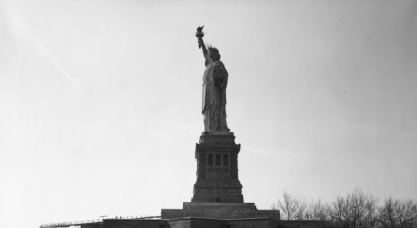
The statue stands 151 feet and 1 inch from base to torch, and 305 feet including the pedestal, which made it the tallest structure in New York City when dedicated in 1886. The copper skin is about 3/32 of an inch thick and weighed 31 tons, atop a 125-ton iron frame. The statue turned green gradually as its copper oxidized, with the patina fully developed by around 1920. Bedloe’s Island was officially renamed Liberty Island in 1956, and the monument was designated a UNESCO World Heritage Site in 1984. During the 1984 to 1986 centennial restoration, the corroded original torch was replaced with a new flame covered in 24-karat gold leaf; the original is now displayed in the Statue of Liberty Museum.
Why the Story Still Matters
The Statue of Liberty endures because it was never just a gift between governments. It was funded by schoolchildren in French villages and newspaper readers in New York tenements, designed by an artist obsessed with scale and an engineer obsessed with wind loads, and layered over time with meanings its creators never planned. Nearly 140 years after its dedication, roughly 3 to 4 million people visit Liberty Island in a typical year, and the statue remains the image most closely associated with the United States around the world, a French idea that Americans finished paying for one penny at a time.
FAQ
Why did France give the Statue of Liberty to America?
To celebrate the centennial of American independence, honor the Franco-American alliance dating to the Revolutionary War, and mark the abolition of slavery. French liberals also intended it as a subtle critique of their own authoritarian government under Napoleon III.
Who built the Statue of Liberty?
Sculptor Frédéric Auguste Bartholdi designed the figure, and engineer Gustave Eiffel, later famous for the Eiffel Tower, designed the internal iron framework that supports the copper skin.
Who paid for it?
The French public funded the statue itself through donations and events, raising roughly 400,000 francs. Americans funded the pedestal, with more than 120,000 people donating about $102,000 through Joseph Pulitzer’s newspaper campaign in 1885.
When was the Statue of Liberty dedicated?
October 28, 1886, in a ceremony led by President Grover Cleveland on what was then Bedloe’s Island, renamed Liberty Island in 1956.
What do the broken chains at her feet mean?
They symbolize the abolition of slavery in the United States, a core part of the monument’s original meaning that founder Édouard de Laboulaye, a leading French abolitionist, insisted upon.
Editorial Note: This article was prepared using publicly available information from international news organizations and official sources available at the time of publication. Facts may be updated as authorities release new information.
Sources: